

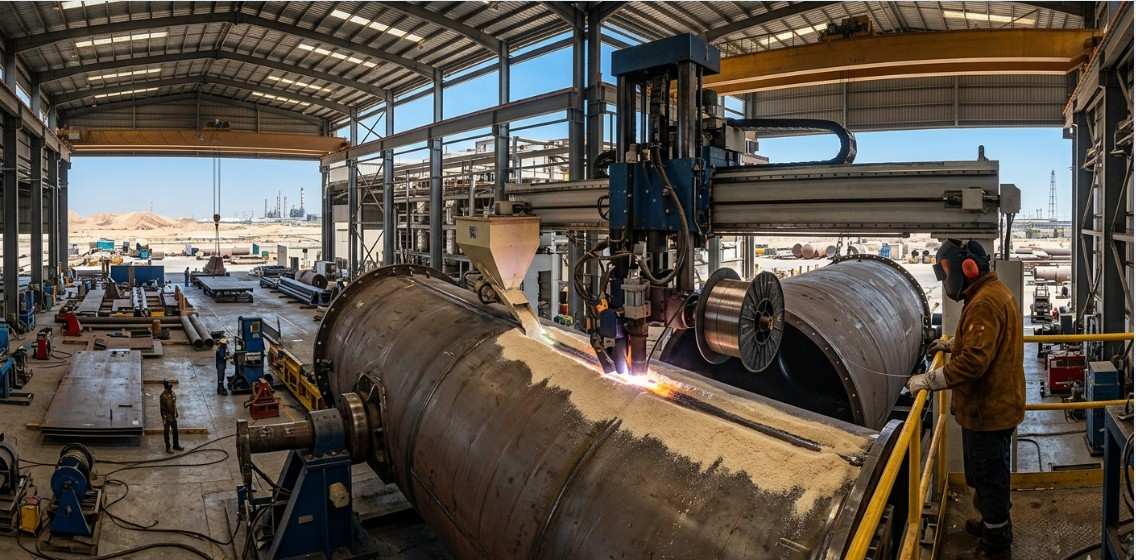
Introduction to Submerged Arc Welding
Submerged Arc Welding (SAW) is an industrial process where a continuous‑feed electrode forms an arc beneath a layer of granular flux, protecting the weld from contamination. This produces high‑quality welds with minimal spatter and reduced fumes. SAW is largely automated, making it ideal for large-scale, repetitive heavy fabrication tasks.
In the UAE, SAW supports critical industries such as oil and gas, petrochemicals, construction, maritime engineering, and infrastructure. Its efficiency, strength, and repeatability make it essential for meeting demanding project standards.
Fundamental Principles of Submerged Arc Welding
Process Description
In Submerged Arc Welding, an electric arc is struck between a continuously fed consumable electrode and the base material. The entire weld zone is covered by powdered flux that melts and creates a protective slag layer. This layer serves multiple purposes:
- Shielding from Atmospheric Contamination: The flux prevents oxygen and nitrogen from entering the weld pool, which reduces the risk of porosity and weld defects.
- Flux Conductivity: Once molten, the flux becomes conductive, enabling current flow between electrode and workpiece without spatter or visible arc.
- Thermal Insulation: The flux insulates the weld, stabilizing heat input and minimizing distortion.
Equipment and Automation
SAW systems in UAE fabrication yards often include welding heads, flux feeders, and automated manipulators to handle large steel plates efficiently.
To enhance productivity, many workshops rely on specialized SAW/Gouging machines that are designed for continuous, high-precision welding operations, ensuring consistent results across heavy structural components.
Advantages of Submerged Arc Welding for Heavy Fabrication
High Deposition Rates and Productivity
Submerged Arc Welding is known for extremely high deposition rates, often far exceeding other arc welding techniques. This translates into faster welding speeds and increased throughput, which is particularly beneficial for high volume or large dimension components such as pressure vessels, structural steel sections, and pipeline segments.
High deposition reduces project timelines and associated labor costs in fabrication shops.
Deep Penetration and Structural Integrity
SAW produces welds with deep penetration, making it ideal for joining thick plate materials commonly encountered in heavy fabrication.
Deep penetration ensures full fusion and high mechanical strength in welded joints, which is essential for applications where structural performance under load is critical.
Consistent and High‑Quality Welds
The submerged nature of the arc results in uniform welds with consistent bead profiles and minimal inclusions. This consistency is crucial for projects subject to stringent quality standards and testing regimes such as ASME (American Society of Mechanical Engineers) and API (American Petroleum Institute) specifications, which govern many fabrication projects in the UAE’s industrial sectors.
Reduced Fumes and Improved Worker Safety
Although SAW operates at high temperatures and currents, the protective flux layer significantly suppresses visible sparks and fumes, contributing to a safer and cleaner working environment.
Reduced operator exposure to arc light and spatter improves workshop safety and can enhance productivity by minimizing interruptions.
Cost‑Effectiveness for Large Projects
While the initial equipment investment for SAW systems and automation can be high, the lifecycle cost per weld tends to be lower than many other methods due to reduced labor demands, less post‑weld repairing, and minimal post‑weld cleaning required.
These factors contribute to cost savings in the heavy fabrication of large structures.
Comparison of Submerged Arc Welding (SAW) with Other Welding Processes
The following table compares SAW with other common welding processes to highlight its advantages for heavy fabrication projects in the UAE.
| Welding Process | Deposition Rate | Weld Quality | Suitable Material Thickness | Automation Capability | Typical Use in UAE Heavy Fabrication |
|---|---|---|---|---|---|
| Submerged Arc Welding (SAW) | Very high | Excellent, deep penetration | Medium to very thick plates | High (mechanized/automated) | Pipelines, pressure vessels, structural steel, offshore components |
| Shielded Metal Arc Welding (SMAW) | Moderate | Good, but more spatter | Thin to medium plates | Low | Small structural repairs, site welding where mobility is needed |
| Gas Metal Arc Welding (GMAW / MIG) | Moderate to high | Good, minimal spatter | Thin to medium plates | Medium | Structural steel, fabrication shops, general assembly |
| Flux-Cored Arc Welding (FCAW) | High | Good, some slag cleaning required | Medium to thick plates | Medium | Heavy steel structures, shipbuilding, offshore components |
| Gas Tungsten Arc Welding (GTAW / TIG) | Low | Excellent, precise | Thin to medium plates | Low | Critical joints requiring high precision, stainless steel and aluminum |
Applications of Submerged Arc Welding in UAE Heavy Fabrication
Oil, Gas, and Petrochemical Infrastructure
The UAE’s oil and gas sector, which accounts for a significant share of regional welding equipment consumption, relies heavily on robust welding processes for pipelines, pressure vessels, storage tanks, and offshore platforms.
SAW’s ability to produce strong, reliable welds in long seams makes it well‑suited for these applications. Continuous welding of pipeline sections and components in fabrication yards reduces installation bottlenecks during project execution.
Structural Steel Fabrication
Large structural steel elements used in bridges, industrial plants, and commercial infrastructure benefit from SAW’s power to handle thick sections efficiently.
Welds in structural steel must withstand high loads and environmental stressors; SAW’s deep penetration and consistent quality support these requirements in fabrication plants across the UAE.
Marine and Shipbuilding Projects
Maritime engineering and shipbuilding yards in the UAE draw upon SAW for hull components, frames, and other large subassemblies. The process’s suitability for long, straight welds on heavy plated elements makes it an effective choice for marine fabrication.
In some cases, SAW complements other welding processes within integrated fabrication lines.
Heavy Mechanical and Offshore Structures
Fabricating offshore platforms and heavy machinery frames requires precise control over welding parameters to withstand stress and corrosion. Advanced solutions like the NGEN-GAU1000 system provide automated control and consistency, making it easier to achieve defect-free welds on thick or complex components.
Case Insights and Industry Examples
Pipeline Fabrication
Major pipeline projects within the UAE, such as the extensive Habshan–Fujairah oil pipeline, involve welding long stretches of large‑diameter pipe. While specific welding details for each project vary, fabrication of pipe sections often employs high‑capacity SAW systems to ensure welds meet mechanical and safety specifications for high‑pressure oil transport infrastructure.
Industrial Fabrication Workshops
UAE fabrication shops working with pipelines, pressure vessels, and structural steel need reliable consumables to maintain weld quality. Using high-quality SAW/Gouging Consumables ensures smooth arcs, minimal spatter, and optimal penetration, supporting long production runs without interruptions..
Challenges and Considerations
Positional Limitations
- SAW is generally limited to flat and horizontal groove welding because molten flux and slag need support.
- This makes it less suitable for complex, vertical, or overhead welds without specialized fixturing or equipment.
Joint Preparation and Setup
- Precise joint preparation and workpiece alignment are essential for optimal weld quality.
- Thick plates often require beveling and careful fit-up, adding preparatory work before welding.
Equipment Mobility
- Large SAW systems and automation frames are less portable.
- Best suited to controlled workshop environments rather than on-site field welding, requiring proper planning and logistics.
AI Overview
This blog covers the role of Submerged Arc Welding (SAW) in UAE heavy fabrication, highlighting benefits, applications, challenges, and why SAW is essential for pipelines, steel structures, and industrial projects.
FAQs
What industries in the UAE most commonly use Submerged Arc Welding (SAW)?
SAW is widely used in heavy fabrication for oil and gas infrastructure, pressure vessels, shipbuilding, and structural steel projects.
Why is SAW preferred over other welding methods for thick steel applications?
SAW delivers deep penetration and high deposition rates, enabling strong, consistent welds on thick plates with fewer passes than many other processes.
What are the main limitations of Submerged Arc Welding?
SAW is typically limited to flat and horizontal positions and requires precise joint preparation, making it less versatile for complex geometries.
Is SAW suitable for all metal types?
SAW works well for carbon steels, low‑alloy steels, stainless steel, and some nickel alloys but is not ideal for non‑ferrous metals like aluminum and magnesium.
Conclusion
Submerged Arc Welding (SAW) plays a pivotal role in UAE heavy fabrication, offering unmatched productivity, deep penetration, and consistent weld quality. Its applications span oil and gas infrastructure, structural steel, pipelines, and marine fabrication, making it indispensable for large-scale industrial projects. While SAW has limitations such as positional constraints and equipment mobility, careful planning, skilled operation, and automation maximize its efficiency and cost-effectiveness.
For reliable welding solutions, certified consumables, and expert technical support in UAE, NGEN Global is your trusted partner for high-performance equipment, professional guidance, and customized solutions for every industrial welding project.
Contact our welding experts for personalized advice and fast, accurate quotations.
Related Guides and Resources
- Types of Welding Machines: Choose the Right One: Optimize your TIG and MIG projects with the right machine selection.
- What is Plasma Arc Welding and What is it Used For: Understanding plasma arc welding, its applications, and industrial benefits.
- What Is ARC/MMA Welding? Process, Uses & Advantages: Learn the basics and applications of ARC/MMA welding.
- What is MIG Welding and How Does It Work? Beginner’s Guide: Understand MIG welding and how it compares to TIG.
- What is TIG Welding? A Comprehensive Guide: Master TIG Welding: Precision, Applications, and Expert Insights.
