

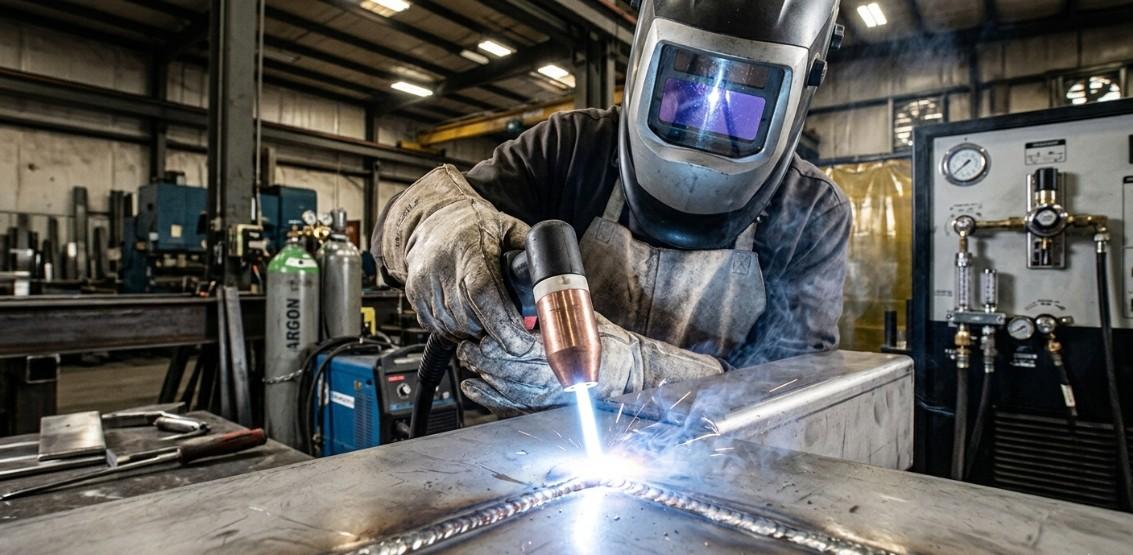
Plasma Arc Welding (PAW) is a high-precision welding process that uses a constricted, ionized gas plasma to fuse metals. Unlike conventional methods, PAW welding provides exceptional control, deep penetration, and minimal distortion, making it ideal for industries requiring flawless, high-quality joints.
Engineers and fabricators rely on this technique for delicate and critical applications, from aerospace components to medical devices.
What Is Plasma Arc Welding
Plasma Arc Welding is an advanced welding method that employs a tungsten electrode within a torch to generate a concentrated plasma welding process. The arc is constricted by a fine-bore nozzle, creating a high-energy plasma jet that melts metal precisely. This separation of the arc from shielding gas gives PAW welding superior stability, faster speeds, and consistent results.
Operators typically use advanced plasma welding machines to achieve these precise arcs and maintain stable performance across various applications. PAW is distinct from TIG welding because it allows both transferred and non-transferred arcs, offering flexibility across thin and thick materials. The ability to switch between “keyhole” and “melt-in” modes makes it a versatile solution for high-demand manufacturing environments.
How Plasma Arc Welding Works
The plasma welding process begins by initiating an electric arc between the tungsten electrode and the workpiece or nozzle. Argon or another inert gas is ionized, producing a plasma stream with temperatures exceeding 20,000°C. This plasma passes through a constriction nozzle, forming a precise high-velocity jet.
The heat melts the base material, forming a weld pool that solidifies into a strong joint. Operators can control welding speed, arc length, and plasma gas flow for accuracy, making it suitable for automated and robotic production lines. Maintaining high-quality welds requires genuine plasma consumables, including electrodes, nozzles, and shielding components
Components of a Plasma Arc Welding System
A typical PAW welding system consists of several critical entities:
- Plasma Torch: Houses the tungsten electrode and nozzle, directing the plasma jet.
- Power Supply: Provides stable current and high-frequency arc initiation.
- Plasma and Shielding Gas: Argon or helium creates the plasma and protects molten metal.
- Cooling System: Prevents overheating of the torch during high-energy welding.
- Control Console: Allows precise parameter adjustment for repeatable weld quality.
Each component ensures consistent results and minimizes defects in demanding industrial applications.
Types of Plasma Arc Welding
Understanding the different plasma welding types is essential for selecting the right method for each project. Each type has unique characteristics, advantages, and ideal applications in industrial settings.
Transferred Arc Plasma Welding
In transferred arc welding, the electric arc flows directly from the tungsten electrode to the workpiece. This creates a highly concentrated and stable heat source capable of deep penetration, making it ideal for thick metals and structural components.
Transferred arc PAW is widely used in aerospace, automotive, and heavy machinery manufacturing where strong, defect-free joints are critical.
Non-Transferred Arc Plasma Welding
The non-transferred arc remains confined between the electrode and the nozzle rather than touching the workpiece. This generates a controlled plasma stream with lower heat intensity, making it suitable for thin or delicate materials.
Non-transferred arc welding is often applied in microfabrication, precision electronics, and surface treatment processes where minimal heat distortion is required.
Micro-Plasma Welding
Micro-plasma welding produces extremely fine, precise arcs for miniature or intricate components. This method is ideal for applications requiring high accuracy and minimal thermal impact, such as medical instruments, electronic sensors, and small aerospace parts.
Micro-plasma systems often operate at low amperages and include advanced control features for automated manufacturing.
Keyhole Plasma Welding
Keyhole welding is a specialized technique that creates a small hole through the base material, allowing full penetration in thick metals. As the plasma jet moves along the weld seam, the molten material flows around the keyhole, forming a strong, uniform joint.
This method is essential for pressure vessels, pipelines, and structural aerospace components where maximum weld strength is required. For thick materials requiring full penetration, specialized systems like the NGEN-CUT120 ensure precise and uniform keyhole welds.
Melt-In Plasma Welding
Melt-in welding is designed for delicate or thin materials, where the plasma energy is carefully controlled to minimize heat impact. This technique allows the base metal to melt gradually without burning through or causing distortion. Melt-in PAW is commonly used in jewelry, medical devices, and thin-sheet metal fabrication.
Advantages of Plasma Arc Welding
PAW welding offers several advantages over conventional welding techniques:
- Precision control with minimal spatter.
- Deep penetration for thick materials.
- Narrow heat-affected zone reduces distortion.
- High welding speeds improve productivity.
- Fully compatible with automated and robotic welding.
To achieve high-speed, deep-penetration welds with consistent results, manufacturers often rely on machines like the NGEN-CUT200, optimized for demanding industrial applications. These benefits make PAW essential in sectors where quality, repeatability, and safety are paramount.
Disadvantages and Limitations
Despite its benefits, plasma welding has limitations:
- Equipment cost is higher than conventional welding systems.
- Skilled operators are required for optimal results.
- Maintenance is complex due to the precision components.
- The process produces UV radiation and noise, requiring safety precautions.
These considerations are important for companies planning large-scale or high-precision projects.
Plasma Arc Welding vs TIG Welding
| Feature | Plasma Arc Welding | TIG Welding |
|---|---|---|
| Arc Control | Constricted and precise | Broader arc |
| Penetration | Deep, up to 10mm | Moderate, limited for thick metals |
| Speed | Faster welding | Slower process |
| Automation | Highly compatible | Limited |
| Material Flexibility | Thin to thick metals | Thin metals primarily |
This comparison helps fabricators choose the optimal method for efficiency, quality, and cost-effectiveness. While PAW is ideal for deep penetration, manufacturers often rely on TIG welding machines for thin metals or precision applications where slower, controlled welds are preferred
What is Plasma Arc Welding Used For
PAW welding finds applications in industries requiring precision and reliability:
- Aerospace
Plasma Arc Welding is used to fabricate titanium and stainless steel engine parts, airframes, and structural components. Its precision and deep penetration ensure defect-free joints critical for flight safety and performance. - Automotive
In the automotive industry, PAW creates steel tubes, airbag components, battery casings, and EV parts. The process delivers consistent weld quality while maintaining high-speed production for complex assemblies. - Medical Devices
PAW is ideal for surgical instruments, implants, and sensitive electronic components, where micro-level accuracy and minimal thermal distortion are essential to maintain functionality and sterility. - Electronics
Plasma welding supports microfabrication and sensor assemblies, providing the precision required for fine circuitry and miniature components in high-tech devices. - Marine & Nuclear
Critical defect-free joints in harsh environments, such as marine vessels or nuclear equipment, are achieved with PAW due to its deep penetration and consistent weld quality under stringent standards.
Its adaptability to automated and robotic systems makes Plasma Arc Welding the preferred method for high-volume, high-precision industrial production, reducing defects and improving efficiency.
Materials That Can Be Welded Using PAW
Plasma welding works with a wide range of metals, providing versatility for manufacturers:
- Stainless steel
- Titanium
- Nickel and cobalt alloys
- Copper and brass
- Thin foil metals
This broad material compatibility increases its value in high-tech fabrication industries.
When to Use Plasma Arc Welding
Choose PAW welding when precision, speed, and quality are critical. Thin or delicate materials, deep-penetration requirements, or automated production lines benefit most.
Avoid conventional methods when defect tolerance is low or material specifications demand exacting standards.
Safety Considerations
Plasma welding requires strict safety measures:
- Use protective gear including gloves, helmets, and eye shields.
- Ensure proper ventilation to avoid harmful fumes.
- Control exposure to UV radiation.
- Train operators on proper torch handling and emergency procedures.
Safety is critical to maintain productivity and prevent accidents in industrial environments.
FAQs
What gas is used in plasma arc welding
Argon or helium is commonly used to ionize the arc and shield the weld pool. These inert gases ensure a stable plasma stream and prevent oxidation during welding.
Can plasma arc welding weld thick materials
Yes, PAW can weld metals up to 10 millimeters or more using the keyhole technique. This allows full penetration and strong, defect-free joints in thick components.
Is plasma arc welding better than TIG welding
Plasma Arc Welding offers deeper penetration, higher speed, and better automation than TIG. It is preferred when precision, consistency, and minimal distortion are critical.
What industries use plasma arc welding
Aerospace, automotive, medical, electronics, and nuclear industries rely on PAW. It is used wherever high-precision, defect-free welds are essential for performance and safety.
Conclusion
Plasma Arc Welding is a versatile and high-precision welding method that excels in applications requiring deep penetration, minimal distortion, and consistent, defect-free results. Its ability to work with both thin and thick materials, coupled with compatibility for automated and robotic systems, makes PAW an essential choice across industries such as aerospace, automotive, medical, and electronics.
By understanding the different types of plasma welding, selecting the appropriate method, and following proper safety and operational guidelines, manufacturers can ensure high-quality outcomes, increased efficiency, and reduced material waste.
For reliable plasma arc welding solutions, genuine consumables, and professional technical support in the UAE, NGEN Global is your trusted partner for high-quality equipment, expert guidance, and customized solutions for every welding project.
Contact our welding experts for personalized advice and fast, accurate quotations.
Related Guides and Resources
- Types of Welding Machines: Choose the Right One: Optimize your TIG and MIG projects with the right machine selection.
- The Guide to Selecting the Right Stainless Steel Welding Rods: Ensure strong, reliable welds for every stainless steel application.
- What Is ARC/MMA Welding? Process, Uses & Advantages: Learn the basics and applications of ARC/MMA welding.
- What is MIG Welding and How Does It Work? Beginner’s Guide: Understand MIG welding and how it compares to TIG.
- What is TIG Welding? A Comprehensive Guide: Master TIG Welding: Precision, Applications, and Expert Insights
