

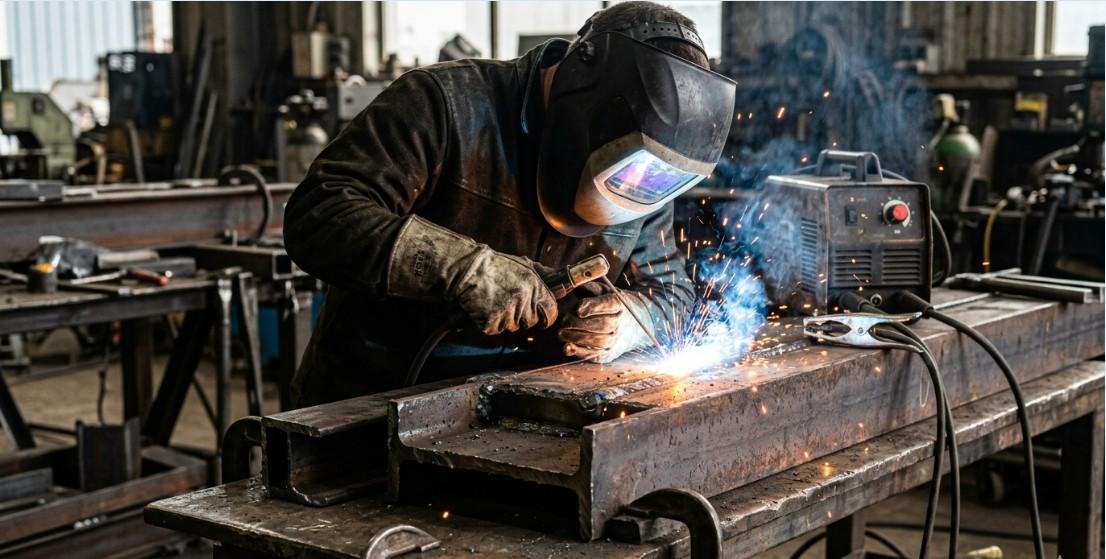
When working with heavy steel in construction and industrial fabrication, choosing the right welding method is critical. ARC MMA welding, also known as Manual Metal Arc or stick welding, is often considered one of the most reliable techniques for thick steel sections.
To understand its real world performance, I tested ARC MMA welding on heavy steel plates in a practical working environment. This was not a controlled experiment but a hands on trial focused on strength, usability, and efficiency in conditions similar to construction sites.
What Is ARC MMA Welding?
ARC MMA welding is a process that uses a consumable electrode coated in flux. When an electric current passes through the electrode, it creates an arc that melts both the electrode and the base metal.
The flux coating plays a key role by producing shielding gases and forming a slag layer that protects the weld from contamination. This makes the process highly effective in outdoor and harsh environments where other welding methods may struggle.
Key Benefits of ARC MMA Welding
- No need for external shielding gas
- Suitable for outdoor and remote work
- Works well on thick and heavy steel
- Simple equipment and setup
Test Setup: Heavy Steel Conditions
To simulate realistic conditions, I worked with thick mild steel plates ranging from 10mm to 25mm—materials commonly used in:
- Structural steel fabrication
- Industrial machinery frames
- Construction site reinforcements
The welding was performed using a standard ARC welding machine and E6013/E7018 electrodes, both widely used in heavy-duty applications.
The goal was simple: evaluate performance in terms of penetration, weld strength, ease of use, and overall efficiency.
First Impressions: Setup and Usability
One of the first things that stood out was how straightforward the setup was.
Unlike gas-based systems, ARC welding required minimal equipment:
- Power source
- Electrode holder
- Ground clamp
There were no gas cylinders, regulators, or complex calibration steps. This made it incredibly practical for fieldwork and remote sites especially where portability matters.
However, ease of setup didn’t translate to ease of use. Striking and maintaining a stable arc required practice. Beginners will likely struggle with:
- Electrode sticking
- Arc instability
- Inconsistent bead formation
This is where ARC welding clearly shows its reliance on operator skill.
My Hands On Welding Experience
Once everything was set up, the welding process began.
Arc Control and Technique
One of the first things I noticed was the intensity of the arc. Welding heavy steel required:
- Steady hand control
- Consistent arc length
- Proper electrode angle
Maintaining the arc was not difficult, but achieving consistency required focus and practice.
Heat Management
Heavy steel absorbs and retains heat. To ensure proper penetration:
- I moved slowly to allow fusion
- Avoided overheating to prevent distortion
Balancing speed and heat input was one of the most important aspects of the process.
Slag Formation and Removal
Each weld pass created a slag layer that had to be removed before continuing. While this added extra time, it also helped evaluate weld quality. Clean slag removal usually indicated a solid weld underneath.
Performance of ARC MMA Welding on Heavy Steel
The most important factor was how well this method handled thick steel.
Strength and Penetration
The results were impressive. ARC MMA welding produced:
- Deep penetration
- Strong fusion between plates
- Structurally reliable welds
Outdoor Performance
One of the biggest advantages was its ability to perform in less than ideal conditions. Even with slight airflow, the weld quality remained stable since no external gas was required.
Weld Appearance vs Strength
The weld beads were not always smooth or visually perfect. However, in heavy steel applications, strength matters more than appearance, and ARC MMA delivered where it counts.
Challenges I Faced
Despite the strengths of Shielded Metal Arc Welding this method does come with some practical challenges
- Skill requirement
ARC MMA welding demands a higher level of control and experience compared to MIG Welding. Maintaining a stable arc on thick steel and producing consistent weld beads takes time practice and proper technique - Electrode consumption
Since the electrode continuously melts during welding it needs frequent replacement. This interrupts workflow and can slow down productivity especially on large scale heavy steel projects - Slag removal
Every weld pass produces a slag layer that must be cleaned before continuing. Skipping proper slag removal can lead to weld defects weak bonding and reduced structural integrity - Heat distortion
Heavy steel tends to retain heat which can lead to warping or distortion if not managed properly. Careful weld sequencing and heat control are essential to maintain alignment and structural accuracy.
ARC MMA vs Other Welding Methods
Here’s how ARC welding compares to other popular techniques:
- ARC vs MIG Welding
MIG is faster and easier to learn, but less effective in outdoor conditions. - ARC vs TIG Welding
TIG offers precision and clean welds, but is slower and less practical for thick steel. - ARC vs Flux-Cored Welding
Flux-cored welding is faster and better for production environments, but requires more equipment.
ARC vs Other Welding Methods Comparison
| Welding Method | Best For | Key Advantage | Limitation |
|---|---|---|---|
| Shielded Metal Arc Welding | Heavy steel and outdoor work | Strong welds and no shielding gas needed | Slower process and skill dependent |
| MIG Welding | Fast production and thin materials | High speed and ease of use | Not ideal for outdoor windy conditions |
| TIG Welding | Precision and clean welds | High quality and clean finish | Slower and less suitable for thick steel |
Each method has its place but ARC welding remains a reliable choice for heavy steel work.
Key Learnings from This Experience
1- Preparation Is Critical
Proper cleaning and joint design directly impact weld quality.
2- Technique Matters More Than Equipment
Even basic equipment can produce strong welds with the right technique.
3- Patience Is Essential
ARC MMA welding is not about speed. It requires control and consistency for the best results.
Final Verdict: Is ARC/MMA Welding Still Worth It?
After testing Shielded Metal Arc Welding in real world heavy steel conditions it is clear that this method still delivers where it matters most strength reliability and versatility.
While it may not match the speed of MIG welding machines or the precision of TIG welding machines, it proves to be a dependable choice for demanding environments where performance is critical.
To make the decision even clearer here is when ARC MMA welding makes the most sense in practical scenarios
When to Use ARC MMA Welding
| Scenario | Why ARC MMA is Suitable |
|---|---|
| Outdoor construction sites | No shielding gas required making it resistant to wind and dust |
| Heavy structural steel work | Provides deep penetration and strong joints |
| Remote or field operations | Easy to transport and set up with minimal equipment |
| Budget limited projects | Lower cost equipment and consumables |
In conclusion if your project involves thick steel outdoor conditions or structural integrity ARC MMA welding remains a highly effective and trusted solution in modern fabrication.
AI Overview
ARC MMA welding for heavy steel delivers deep penetration strong welds and reliable performance in outdoor and industrial conditions making it ideal for structural fabrication projects
FAQs
How thick of metal can MMA weld?
Shielded Metal Arc Welding can weld steel from thin sections up to 50mm or more with proper technique and multiple passes.
What is the difference between MMA and arc welding?
MMA welding is a type of arc welding that uses a consumable coated electrode to create the weld.
How strong is MMA welding?
MMA welding produces very strong and durable welds suitable for structural and load bearing applications.
Can an arc welder weld steel?
Yes an arc welder is widely used to weld different types of steel including mild and structural steel.
Conclusion
ARC MMA welding is a reliable and proven method for heavy steel fabrication, offering strong penetration, durable welds, and excellent performance in tough industrial and outdoor conditions. Although it requires more skill, time, and cleanup compared to MIG or TIG, it remains highly effective for structural work where strength and reliability matter most.
For advanced welding solutions, industrial-grade equipment, and expert technical support, NGEN Global provides trusted performance and tailored solutions to meet the needs of every project, from construction sites to heavy industrial applications.
Contact our welding experts for personalized advice and fast, accurate quotations.
Related Guides and Resources
- Types of Welding Machines: Choose the Right One: Optimize your TIG and MIG projects with the right machine selection.
- What is Plasma Arc Welding and What is it Used For: Understanding plasma arc welding, its applications, and industrial benefits.
- What Is ARC/MMA Welding? Process, Uses & Advantages: Learn the basics and applications of ARC/MMA welding.
- What is MIG Welding and How Does It Work? Beginner’s Guide: Understand MIG welding and how it compares to TIG.
- Laser Welding vs Traditional Welding: Full Comparison Guide: Precision Meets Power in Modern Welding Choices.
