

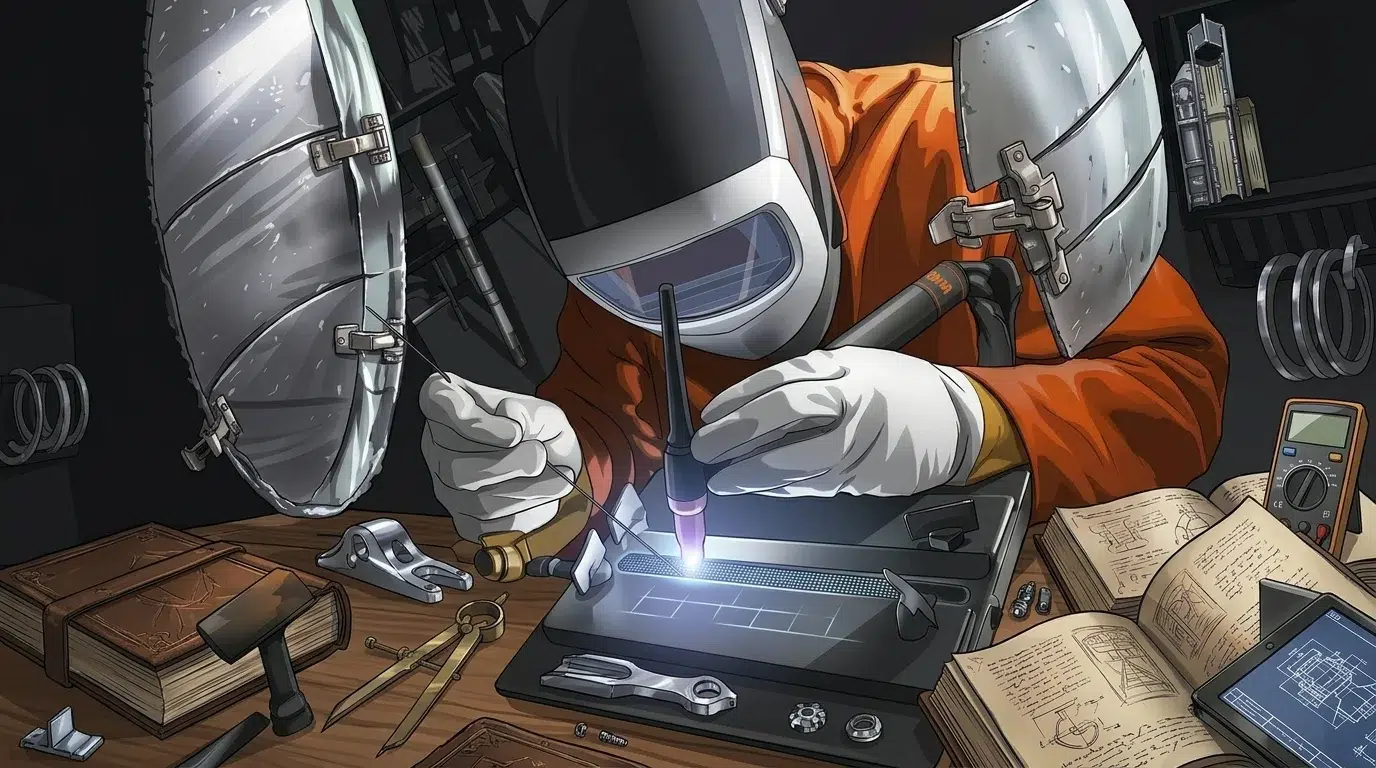
TIG welding applications cover aerospace, motorsport, food grade piping and tool repair. The process gives clean and precise welds on thin and reactive metals. It is also slower and harder to learn than MIG or stick. This guide shows where TIG fits best, what it does well and where it falls short.
TIG welding applications cover some of the most demanding jobs in metal fabrication, from aircraft components to sanitary stainless piping. The process gives you a clean, precise weld, but it asks for more time, skill and budget than most other methods.
This guide shows where TIG makes sense, what it does well, where it struggles and how to decide before you commit to a setup.
What Is TIG Welding and How Does It Work?
TIG welding, short for tungsten inert gas welding, joins metal using an arc between a non-consumable tungsten electrode and the workpiece. A shielding gas, usually argon, protects the weld pool from air. The welder adds filler rod by hand when the joint needs it.
That split between heat and filler is the whole point. One hand holds the torch, the other feeds rod, and a foot pedal or torch control adjusts amperage on the fly. You steer heat and material separately, which is why the process is so precise.
TIG runs on DC for steels, stainless and copper, and on AC for aluminium and magnesium. AC breaks up the oxide layer on aluminium so the pool can flow cleanly.
Which Industries Use TIG Welding Applications?
TIG welding applications are strongest where weld quality matters more than speed. That includes aerospace, motorsport, food and pharmaceutical piping, chemical plants, tool and die repair and decorative stainless work. These sectors accept slower output because a failed weld costs far more than the extra time.
Here is how it plays out on real jobs.
- Aerospace and defence parts that need full penetration and low distortion
- Roll cages, exhaust systems and frames in automotive and motorsport shops
- Sanitary stainless tube in dairy, beverage and pharma lines
- Root passes on pipe that will later be filled with MIG or stick
- Repair of moulds, dies and cutting tools where heat must stay low
- Aluminium, titanium, nickel alloy and copper fabrication
Root passes are a good example of how shops mix processes. A TIG root gives a clean inside bead, then a faster process fills the joint. You get quality where it counts and speed where it does not.
What Are the Advantages of TIG Welding?
The main advantages of TIG welding are precise heat control, clean spatter free welds, and the ability to join almost any weldable metal in any position. It also produces fewer fumes than MIG or stick, and the finished bead often needs little grinding or cleanup.
Precise Heat Control
Because the foot pedal changes amperage while you weld, you can ease off at an edge or build heat on a thicker section without stopping. Thin sheet is where this pays off most, since you can avoid burn through and keep distortion low.
Better Weld Quality
Argon shielding keeps oxygen and nitrogen out of the pool, which cuts porosity and brittleness. That is why TIG shows up in pressure piping, aerospace work and any joint that will be inspected.
Wide Metal Range
Mild steel, stainless, aluminium, titanium, copper, brass and nickel alloys all weld well with TIG. You change the filler and gas, not the whole process, so one machine can cover a mixed workload.
Low Post Weld Cleanup
There is no slag and almost no spatter, so grinding time drops. On visible stainless work, that saves real labour and keeps the finish intact.
All Position Welding
You can weld flat, vertical, horizontal or overhead without changing the basic technique. The same fine control that helps on thin metal also helps you adapt when the joint angle changes.
What Are the Disadvantages of TIG Welding?
The disadvantages of TIG welding are slow travel speed, a long learning curve, higher equipment cost and strict cleanliness requirements. It also performs poorly on thick plate and outdoors, where wind pushes the shielding gas away from the pool.
Slow Welding Speed
Deposition rates are low, so production work costs more per metre of weld than MIG. If volume drives your schedule, this is usually the first limit you will hit.
High Skill Requirement
Two hands and a foot work together. New welders often need months of practice to produce consistent beads, and operator skill shows up directly in weld quality.
Higher Equipment Cost
A good inverter machine, argon cylinder, regulator, water cooled torch for heavy work and consumables add up. Training time adds more.
Clean Metal Only
Rust, oil, paint and mill scale cause porosity and a dirty tungsten. Joint prep takes longer than with stick, so budget time for cleaning before every weld.
Thick Sections
TIG can weld heavy plate, but it needs many passes. Most shops switch to MIG or stick once the thickness climbs.
Wind and Drafts
Even a light breeze can disturb argon coverage. Outdoor jobs usually need screens or a different process.
TIG Welding at a Glance
This table compares TIG with MIG and stick on the points buyers ask about most.
| Factor | TIG | MIG | Stick |
| Weld quality | Highest | Good | Fair to good |
| Speed | Slow | Fast | Moderate |
| Skill needed | High | Low to moderate | Moderate |
| Thin metal | Excellent | Good | Poor |
| Thick metal | Slow | Very good | Very good |
| Outdoor use | Poor | Poor to fair | Very good |
| Equipment cost | Higher | Moderate | Lower |
| Post weld cleanup | Minimal | Some spatter | Slag removal |
How to Choose the Right TIG Welding Machine for Industrial Work
Choosing the right TIG welding machine depends on the type of work, material thickness, power supply, and production requirements. A machine selected for light workshop repairs may not provide the output or features needed for continuous industrial fabrication. Before selecting a machine, consider the materials you work with and the welding conditions in your facility.
You can explore different TIG welding machines to compare available options for your industrial requirements.
Check the Material You Need to Weld
Start by identifying the metals used in your projects. Stainless steel, carbon steel, and aluminium have different welding requirements.
Consider Material Thickness and Welding Current
The thickness of the material determines the current range required for the job. Thin sheets need lower current settings to prevent burn-through, while thicker materials generally require higher output or multiple welding passes.
Check the machine’s minimum and maximum current range before purchasing. Make sure it supports the thicknesses and joint types commonly used in your workshop.
Choose the Right Power Supply
Industrial welding machines are available with different input power requirements. Some operate on single-phase power, while others require a three-phase supply.
Check the electrical supply available at your facility before selecting a machine. Choosing equipment that matches the site’s power capacity helps avoid installation problems and unnecessary operating limitations.
Review Duty Cycle and Working Conditions
Duty cycle indicates how long a welding machine can operate at a specified output within a ten-minute period before requiring a cooling period.
For industrial environments with frequent or extended welding tasks, consider a machine with a suitable duty cycle. Also review its cooling system, operating environment, portability, and maintenance requirements.
Check Machine Features and Accessories
Additional features can improve control and make the machine more suitable for specific jobs. Depending on your requirements, consider:
- AC/DC capability: Useful when working with both aluminium and steel.
- Pulse TIG: Helps control heat input and the weld pool.
- High-frequency start: Allows arc starting without touching the tungsten electrode to the workpiece.
- Adjustable current: Helps match output to material thickness.
- Gas control: Supports proper shielding during welding.
- Foot pedal compatibility: Gives the operator additional control over welding current.
Compare these features with your actual production needs rather than paying for functions that your workshop will rarely use.
Safety Requirements for TIG Welding
TIG welding requires suitable safety measures to protect operators from electrical hazards, ultraviolet radiation, fumes, and hot materials. Even though the process produces relatively little spatter, it still involves high temperatures and an electric arc.
Important precautions include:
- Wear suitable protective equipment: Use a welding helmet with the correct shade, safety glasses, welding gloves, protective clothing, and appropriate footwear.
- Maintain proper ventilation: Ensure the work area has adequate ventilation to control welding fumes and gases.
- Protect nearby workers: Use welding screens or barriers to reduce exposure to arc radiation.
- Check electrical connections: Inspect cables, torch connections, and grounding before starting work.
- Keep the work area clear: Remove flammable materials and follow appropriate hot-work procedures.
- Handle gas cylinders safely: Secure cylinders upright and use suitable regulators and connections.
- Inspect equipment regularly: Check the torch, cables, gas lines, and other components for damage or wear.
Following the correct safety procedures helps reduce workplace risks and supports consistent welding operations.
Conclusion
TIG welding applications reward patience. You get clean, strong and precise welds on thin, reactive and high value metals, and you pay for it in speed, skill and cost. Knowing those trade offs up front keeps projects on budget and welds on spec.
If you are planning a TIG setup or upgrading an old one, the team at NGEN Global can help you choose equipment that fits your metals, your workload and your team.
Get the right TIG setup for your workshop
Whether you are adding TIG for stainless and aluminium work or replacing an ageing machine, our team will help you match the power source, torch and shielding setup to your metals and workload. You get clear guidance and a straight quote, with no guesswork.
FAQs
Is TIG Welding Hard to Learn?
Yes, it is the hardest of the common processes to learn. You coordinate torch, filler rod and foot pedal at once, and clean technique takes steady practice. Most welders need several months to produce consistent, good looking beads.
What Metals Can You Weld With TIG?
TIG welds mild steel, stainless steel, aluminium, magnesium, titanium, copper, brass and nickel alloys. You switch filler rod and shielding gas to suit the metal, and use AC for aluminium and magnesium.
Is TIG Welding Stronger Than MIG Welding?
TIG is not automatically stronger, but it usually gives cleaner, more precise welds with fewer defects. MIG can produce very strong welds on thicker material and does it much faster, so the better choice depends on the job.
Why Is TIG Welding So Slow?
TIG deposits filler at a low rate because the welder adds rod by hand and controls heat carefully. That slow pace is what gives the process its precision, but it raises labour cost on production work.
Can TIG Welding Be Done Outdoors?
It is possible but not ideal. Wind blows away the argon shield and causes porosity, so outdoor jobs need windbreaks or a more wind tolerant process such as stick.
Read More Welding Machine Blogs
- Types of Welding Machines Choose the Right One Compare TIG, MIG and arc machines to see which suits your metals and workload.
- Top 10 Industrial Applications of Arc Welding See how arc welding is used across industries and how it compares with TIG.
- What Is ARC/MMA Welding? Process, Uses & Advantages Learn the basics of the process you might pair with TIG on thicker or outdoor jobs.
- I Tried ARC/MMA Welding for Heavy Steel Real test results from heavy steel, the kind of work where TIG slows down.
- Best Welding Equipment Suppliers Across the UAE A roundup to help you source TIG and other welding equipment.
