

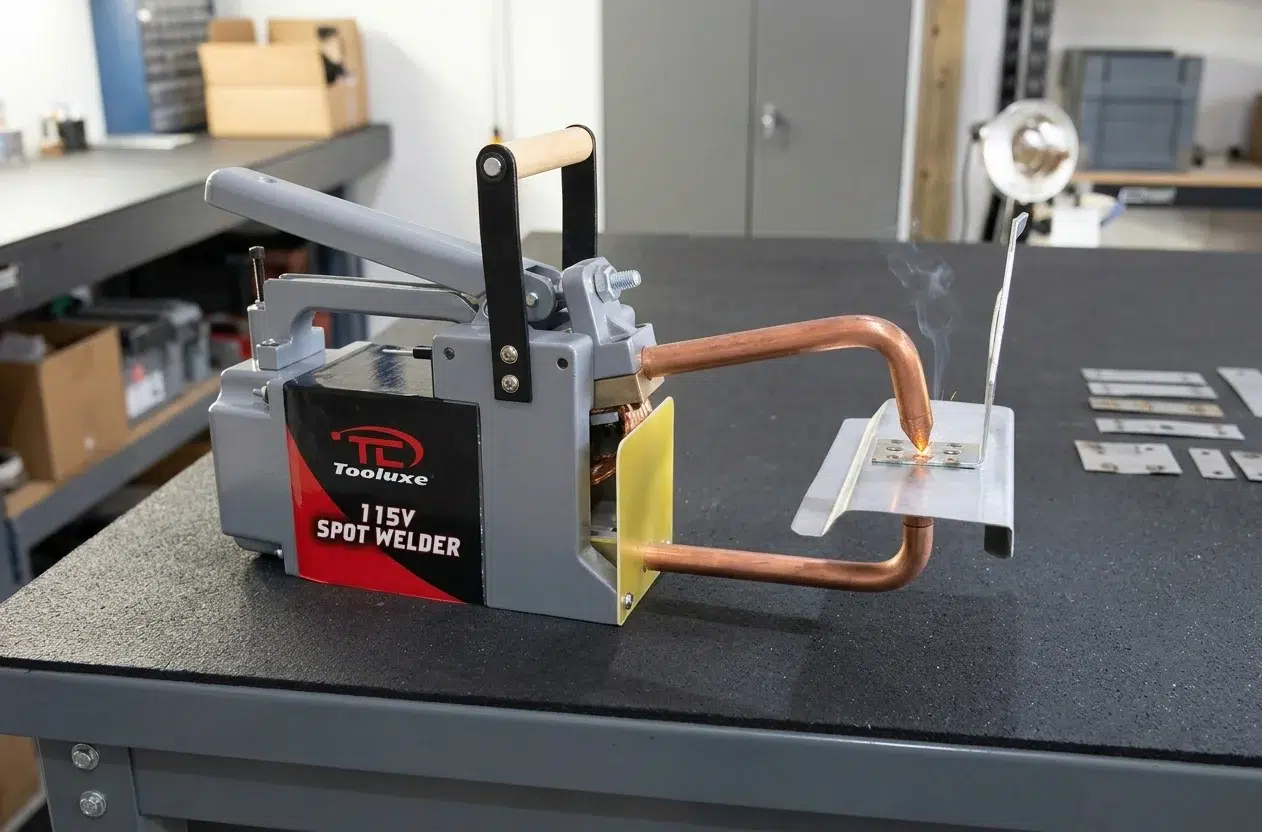
A spot welder joins metal sheets at specific points using heat and pressure. Conventional resistance spot welding uses electrical current and copper electrodes to create strong joints, while laser spot welding uses focused laser energy for precise joining. This guide explains how spot welding works, its applications, advantages and limitations, and what to consider when choosing a machine.
Spot welding is widely used in manufacturing processes where metal sheets need to be joined quickly and consistently. It is commonly found in automotive production, electrical equipment manufacturing, household appliances and general metal fabrication. The process creates localized joints without requiring additional filler material in conventional resistance spot welding.
Understanding how the process works helps manufacturers select suitable equipment, prepare materials correctly and maintain consistent weld quality. This guide explains what is a spot welder, its working process, main components, applications, advantages and important factors to consider when choosing a machine.
What Is a Spot Welder?
A spot welder is a machine used to join two or more overlapping metal sheets at specific points. In conventional resistance spot welding, two copper alloy electrodes apply pressure to the sheets while an electrical current passes through the contact area. The electrical resistance generates heat, causing the metal to melt locally and form a weld nugget.
Once the current stops, the electrodes maintain pressure while the molten area cools and solidifies. This creates a permanent joint between the metal components.
Unlike arc welding processes, conventional resistance spot welding does not require a continuous weld bead or filler material. It is particularly useful for sheet metal assemblies that need multiple repeatable joining points.
Spot welding is also used to describe laser-based joining processes. These use focused laser energy rather than resistance heating between electrodes. The appropriate method depends on the application, material and required level of precision.
How Does Spot Welding Work?
Conventional resistance spot welding works through a combination of electrical current, pressure and controlled welding time. Each factor contributes to the formation and quality of the joint.
The process generally follows these steps:
- Material positioning: The metal sheets are placed in an overlapping position between the welding electrodes.
- Electrode contact: The electrodes move towards the sheets and apply the required pressure.
- Current application: Electrical current passes through the electrodes and the metal contact area.
- Heat generation: Electrical resistance produces concentrated heat at the interface between the sheets.
- Weld formation: The localized metal melts and forms a small molten region known as a weld nugget.
- Cooling: The current stops, but the electrodes continue applying pressure while the molten metal solidifies.
- Electrode release: The electrodes separate, leaving the joined metal sheets.
The heat generated during resistance welding is commonly described by the formula:
Q = I²Rt
Where:
- Q = Heat generated
- I = Electrical current
- R = Electrical resistance
- t = Welding time
Controlling these variables is essential for producing consistent welds. Excessive heat can cause expulsion or damage, while insufficient heat may result in weak joints.
Main Components of a Spot Welding Machine
A conventional resistance spot welding machine contains several components that work together to produce a controlled joint.
| Component | Function |
| Electrodes | Apply pressure and conduct electrical current to the workpieces. |
| Welding transformer | Supplies the required low-voltage, high-current output. |
| Electrode holders | Secure the electrodes in the correct position. |
| Pressure mechanism | Controls the force applied during welding. |
| Control unit | Regulates current, welding time and other process settings. |
| Cooling system | Helps manage heat in the electrodes and machine components. |
| Welding arms | Support and position the electrodes around the workpieces. |
Electrode condition is particularly important because worn, contaminated or incorrectly shaped electrodes can affect contact resistance and weld consistency. Regular inspection and maintenance help maintain reliable performance.
What Materials Can Be Spot Welded?
Spot welding is suitable for several conductive metals, although the required welding parameters vary depending on their electrical and thermal properties.
Common materials include:
- Mild steel: Commonly used because it can be joined effectively through conventional resistance spot welding.
- Stainless steel: Can be spot welded in industrial applications, with suitable control of current, pressure and welding time.
- Galvanized steel: Can be joined using spot welding, but its protective coating may increase electrode wear and require additional process control.
- Aluminium: Requires higher welding currents because of its high electrical and thermal conductivity. It can be more challenging to weld consistently.
- Nickel alloys: Certain nickel-based materials can be joined using suitable resistance welding parameters.
- Titanium: Can be spot welded in selected applications where material preparation and process control are appropriate.
Material thickness, surface condition, coating and joint configuration all influence the final result. Manufacturers should establish suitable welding parameters through testing rather than applying the same settings to every metal.
Common Applications of Spot Welding
Spot welding is used across industries that manufacture products from sheet metal and require repeatable joining points.
Automotive Manufacturing
Automotive manufacturers use spot welding to assemble vehicle body panels, doors, frames and other sheet metal components. Its speed and repeatability make it suitable for high-volume production lines.
Electrical and Electronics Manufacturing
The process is used in selected electrical components, battery assemblies and metal enclosures. The required welding method depends on the material thickness and precision of the application.
Household Appliances
Washing machines, refrigerators, ovens and other appliances often contain sheet metal assemblies. Spot welding can help join their panels and internal metal structures.
Metal Furniture and Fabrication
Manufacturers use spot welding to assemble metal cabinets, frames, brackets and furniture components. It is useful when products require multiple localized joints.
Aerospace and Rail Manufacturing
Spot welding is used in selected sheet metal applications within aerospace and rail manufacturing. Material specifications, joint design and quality requirements determine whether the process is suitable.
Advantages and Limitations of Spot Welding
Understanding the benefits and limitations of spot welding helps manufacturers decide whether the process suits their production requirements.
Advantages
- Fast production: Multiple localized joints can be produced quickly, making the process suitable for repetitive manufacturing.
- No filler material: Conventional resistance spot welding joins metal sheets without additional filler material.
- Repeatable results: Automated equipment can maintain consistent welding parameters across production runs.
- Limited heat-affected area: Heat is concentrated around the joining point rather than applied along a continuous weld line.
- Suitable for automation: Spot welding can be integrated into robotic and automated production systems.
- Reduced finishing requirements: The process generally does not create a continuous weld bead that needs extensive finishing.
Limitations
- Joint design restrictions: Conventional spot welding is primarily suitable for overlapping metal sheets that electrodes can access.
- Material limitations: Highly conductive metals and certain material combinations require specialized equipment and parameter control.
- Electrode maintenance: Electrodes can wear, become contaminated or lose their correct shape over time.
- Thickness restrictions: The process has practical limitations depending on material thickness and machine capacity.
- Access requirements: Both sides of the joint generally need to be accessible for conventional resistance spot welding.
How to Choose the Right Spot Welding Machine?
Choosing a spot welding machine requires an understanding of the materials, production volume and joint requirements. Consider the following factors before selecting equipment.
1. Material Type
Identify the metals you intend to join. Mild steel, stainless steel and aluminium have different electrical and thermal properties, which influence machine requirements and welding parameters.
2. Material Thickness
Check the thickness of the workpieces and the machine’s rated welding capacity. Equipment should be suitable for the combined thickness and material combination being joined.
3. Production Volume
For high-volume manufacturing, consider machines with automated controls and repeatable operating settings. Smaller workshops may require equipment suited to lower production volumes and varied tasks.
4. Power and Current Requirements
The machine must provide sufficient welding current for the selected material and thickness. Its electrical supply and duty cycle should also match the intended operating conditions.
5. Control and Adjustment Features
Look for controls that allow operators to adjust welding current, time and electrode pressure. Consistent parameter control supports repeatable results and helps reduce defects.
6. Maintenance and Cooling
Check the electrode replacement requirements, cooling arrangements and availability of service support. Regular maintenance helps prevent inconsistent welds and unnecessary production interruptions.
7. Welding Technology
Determine whether conventional resistance spot welding or laser spot welding is more appropriate. Laser-based machines can offer precise, localized joining for selected applications, while resistance spot welding is widely used for overlapping sheet metal assemblies.
For businesses exploring industrial welding equipment, NGEN Global offers different machine solutions. You can explore its spot welding machines and equipment to review available options and identify equipment suited to your application.
It is important to compare the machine’s specifications with your actual production requirements before making a decision.
Conclusion
Spot welding is an effective method for joining metal sheets at specific points, particularly in applications that require speed, repeatability and consistent joint quality. Understanding the welding process, material compatibility, machine settings and maintenance requirements helps manufacturers choose the right equipment and achieve reliable results.
Selecting suitable welding equipment also depends on production needs, material thickness and the level of precision required. NGEN Global provides welding machines and solutions for different industrial applications, helping businesses find equipment that supports their metal fabrication requirements.
Looking for the Right Spot Welding Equipment?
Whether you need spot welding equipment for sheet metal fabrication, automotive production or precision industrial applications, NGEN Global can help you explore suitable welding solutions for your requirements. Contact our team to discuss your application and find the right equipment.
Frequently Asked Questions
Is spot welding stronger than MIG welding?
Neither process is universally stronger. Spot welding creates localized joints suitable for sheet metal assemblies, while MIG welding produces continuous weld beads and accommodates a wider range of joint designs and material thicknesses. The stronger option depends on the material, joint design and application.
What metals can be joined using a spot welder?
Common materials include mild steel, stainless steel, galvanized steel, aluminium alloys and certain nickel alloys. However, each material requires suitable welding parameters and equipment. Highly conductive metals such as aluminium can require specialized process control to achieve consistent results.
What is the difference between resistance spot welding and laser spot welding?
Resistance spot welding uses electrical current and pressure applied through electrodes to generate heat and join metal sheets. Laser spot welding uses a focused laser beam to create a localized weld. The two methods differ in their heat sources, equipment, joint requirements and suitable applications.
Read More Welding Machine Blogs
- TIG Welding Applications: Advantages and Disadvantages Explore where TIG welding excels, where it slows down, and how it compares with MIG and arc.
- Top 10 Industrial Applications of Arc Welding See how arc welding is used across industries and how it compares with TIG.
- What Is ARC/MMA Welding? Process, Uses & Advantages Learn the basics of the process you might pair with TIG on thicker or outdoor jobs.
- I Tried ARC/MMA Welding for Heavy Steel Real test results from heavy steel, the kind of work where TIG slows down.
- Best Welding Equipment Suppliers Across the UAE A roundup to help you source TIG and other welding equipment.
