

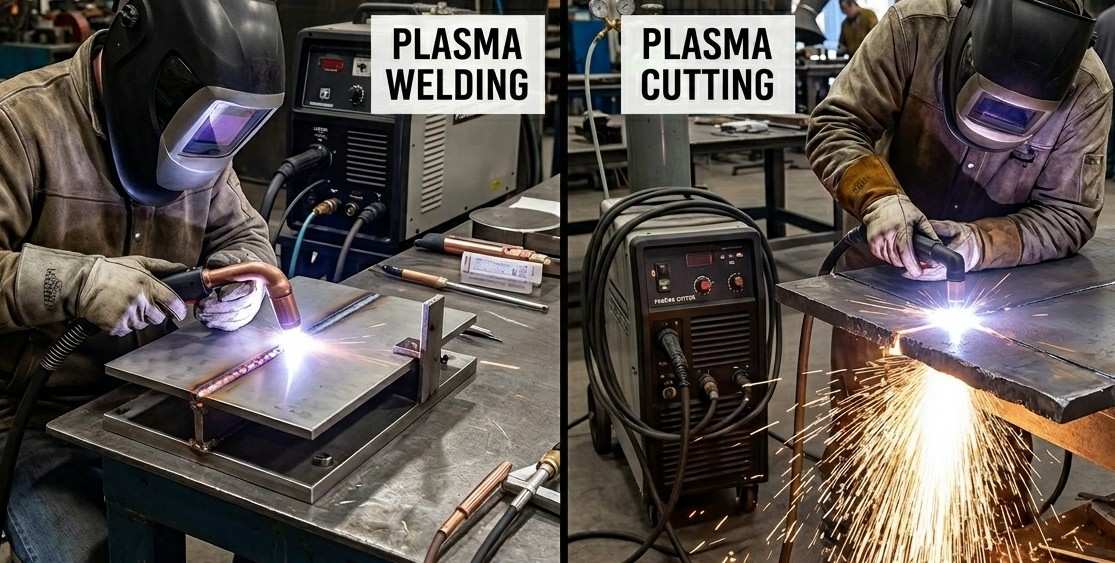
Plasma technology powers metal fabrication across the UAE, from structural steel yards in Jebel Ali to precision workshops in Abu Dhabi and Sharjah’s industrial zones. As demand for faster output and tighter tolerances grows, more buyers are investing in plasma equipment without fully understanding which process fits their production needs.
The confusion between plasma welding and plasma cutting leads to real consequences including wrong equipment purchases, underutilized machines, and production delays that affect project delivery and client relationships. Both processes use plasma technology but are designed for entirely opposite outcomes that cannot be substituted for one another.
This guide breaks down how plasma welding and plasma cutting differ across every variable that matters to UAE buyers, from process mechanics and material compatibility to consumable costs, operator skill, and industry applications across the UAE market.
What Is Plasma Welding?
Plasma Arc Welding (PAW) is a precision joining process that uses a constricted ionized gas arc to fuse metal parts into a single continuous structure with deep penetration and minimal heat spread.
The arc passes through a fine-bore copper nozzle that compresses the plasma stream to a precise working point, producing temperatures exceeding 20,000°C at the weld zone with consistent joint quality.
What separates plasma welding from TIG welding is the physical separation of the plasma arc from the shielding gas, giving the operator far greater stability and control over the heat source throughout the weld cycle. This allows fabricators to work on thin-gauge materials without burn-through risk while also achieving full-penetration welds on thicker metals using the keyhole mode when required.
In the UAE, from aerospace suppliers to pressure vessel producers, plasma welding delivers repeatability that conventional arc processes cannot match at modern production speeds. Reputable Plasma welding machine suppliers carry systems for everything from automated robotic lines to manual precision welding on critical specialty alloy assemblies.
Key Characteristics of Plasma Welding
- Produces a joint by fusing metal together with no material removed from the workpiece during the process
- Operates in keyhole mode for full penetration on thick metals or melt-in mode for thin and delicate materials
- Compatible with stainless steel, titanium, nickel alloys, copper, and most electrically conductive metals
- Highly suited to robotic and CNC automated environments requiring consistent and repeatable daily output
- Demands skilled operators with strong knowledge of arc parameters, gas selection, and material behavior
What Is Plasma Cutting?
Plasma cutting is a thermal separation process designed to cut cleanly through metal at high speed across a wide range of material types and thicknesses. A plasma cutter forces compressed gas through a torch nozzle at high velocity, energizing it with an electric arc that creates a superheated plasma stream reaching up to 30,000°C that melts through conductive metal while expelling molten slag from the kerf.
Unlike oxy-fuel cutting, which is limited to carbon steel and cast iron, plasma cutters work on any conductive metal including mild steel, stainless steel, aluminum, copper, and titanium across a broad thickness range.
This material versatility makes plasma cutting the standard choice for UAE workshops handling mixed-metal projects and high-volume CNC sheet metal production on tight delivery schedules.
Nozzles, electrodes, swirl rings, and shielding cups wear down with regular use and directly affect cut quality and operating costs. Sourcing genuine Plasma Cutting Consumables from established UAE dealers ensures consistent performance, minimizes downtime, and protects the torch and power supply from damage caused by substandard parts.
Key Characteristics of Plasma Cutting
- Removes material by melting and expelling it from the cut zone with no joining of metal taking place
- Cuts through any electrically conductive metal regardless of alloy type or surface condition
- Produces a kerf typically ranging from 2 to 5mm wide depending on amperage and material thickness
- Handles metal thicknesses up to approximately 50mm depending on machine power rating and gas setup
- Significantly faster than oxy-fuel cutting across most common fabrication thicknesses in UAE workshops
Plasma Welding vs Plasma Cutting at a Glance
| Factor | Plasma Welding | Plasma Cutting |
| Primary Purpose | Joins metal parts together | Separates and profiles metal |
| Process Output | Weld bead and fused joint | Kerf and cut edge |
| Operating Temperature | Up to 20,000°C | Up to 30,000°C |
| Heat-Affected Zone | Narrow with minimal distortion | Wider, may need post-processing |
| Material Range | Conductive metals, process-specific | Any electrically conductive metal |
| Thickness Capability | Thin to thick, mode dependent | Up to approximately 50mm |
| Operator Skill Required | High | Moderate |
| Automation Compatibility | High | High |
| Consumable Wear Rate | Moderate | High |
| Typical Equipment Cost | Higher investment | Lower to mid range |
How Plasma Welding and Plasma Cutting Actually Differ
Although both processes use a high-energy plasma arc, they serve fundamentally different purposes, operate under different conditions, and deliver distinct outcomes in metal fabrication and manufacturing environments.
Purpose and Output
The most fundamental difference is what each process produces and what role it plays in the fabrication workflow. Plasma welding creates a metallurgical bond that meets or exceeds the mechanical strength of the parent material across all load directions.
Plasma cutting removes material to create a separation or profile shape that moves forward into further fabrication, assembly, or finishing steps.
Heat-Affected Zone
Plasma welding is engineered to limit heat spread into surrounding base material, making it ideal for thin stainless steel, aerospace titanium, and applications where post-weld distortion causes rejection.
Plasma cutting involves a wider heat-affected zone since the goal is material removal at speed, and cut edges on thicker metals often require grinding or machining before use in precision assemblies.
Consumable Costs and Wear
Plasma cutting consumables wear significantly faster because the cutting arc operates at maximum energy density for sustained periods, eroding nozzle orifices and electrode tips far more rapidly than welding applications.
For UAE fabricators managing tight budgets across multiple shifts, this difference in consumable consumption must factor into the full cost of ownership calculation when comparing both equipment types.
Operator Skill and Training
Plasma cutting is more accessible to operators at different experience levels, especially on manual systems where the machine manages arc initiation and the operator guides the torch along the cut line.
Plasma welding requires deeper knowledge of metallurgy, joint preparation, gas selection, travel speed, and arc length control across different alloys, and UAE companies should budget for structured training alongside any new equipment purchase.
Plasma Welding and Plasma Cutting Applications in the UAE
Both technologies play critical roles across the UAE’s industrial sector, with each serving specific manufacturing, fabrication, and construction requirements.
Industries That Rely on Plasma Welding
- Oil and gas pipeline contractors use keyhole plasma welding for single-pass full-penetration welds, reducing welding time significantly compared to multi-pass TIG on the same diameter pipe
- Pressure vessel and heat exchanger manufacturers depend on plasma welding to consistently meet ASME, API, and EN weld quality standards with repeatable profiles across high-volume production runs
- Aerospace MRO facilities working with titanium and nickel alloys choose plasma welding for its narrow heat-affected zone, reliable penetration, and full compatibility with automated production systems
- Medical device and instrumentation manufacturers rely on micro-plasma welding for precision assemblies where any thermal damage to surrounding components makes the finished part commercially unusable
Industries That Rely on Plasma Cutting
- Structural steel contractors across Dubai and Abu Dhabi use plasma cutting to profile beams, plates, gussets, and connection details for industrial and infrastructure construction projects across the UAE
- Sheet metal workshops use CNC plasma tables to cut precise shapes from mild steel, stainless steel, and aluminum for enclosures, ductwork, cladding panels, and custom fabrication across varying job sizes
- Shipyards and marine fabrication facilities use plasma cutting for hull plate preparation, bracket profiling, and structural component cutting across a full range of steel grades and project specifications
- On-site construction contractors use portable plasma cutters for field modifications where oxy-fuel equipment presents safety, logistics, or regulatory challenges that cannot be easily managed on active sites
Key Buying Considerations for UAE Buyers
Selecting the right plasma technology requires a clear understanding of your production goals, material requirements, and long-term operational needs.
Define Your Application First
If your operation requires joining metal into a finished assembly, a plasma welding system is the correct investment and a plasma cutter will leave that production requirement completely unmet.
If your primary need is profiling or separating metal for downstream fabrication, a plasma cutting system is what belongs in your facility.
Match the Machine to Your Material Range
For operations working regularly with thin stainless steel, titanium, or nickel alloys where distortion control is critical, plasma welding delivers precision that TIG and MIG cannot consistently replicate at production speeds.
For shops handling mixed materials and variable thicknesses, plasma cutting offers the broadest versatility and the lowest barrier to productive daily use across the team.
Factor Consumable Supply into Your Decision
In the UAE market, production continuity depends on the availability of the right consumables at short notice, and both plasma welding and cutting components need regular replacement as part of normal operation.
Working with suppliers who stock genuine consumables locally and respond quickly to urgent requirements is as important as the initial machine selection itself.
Plan for Operator Training from Day One
Plasma welding knowledge does not transfer automatically from MIG or TIG experience without structured hands-on development, and gaps in operator skill directly impact weld quality and rework rates.
UAE fabrication companies that invest in proper training alongside equipment purchase consistently achieve better output quality, lower consumable waste, and longer torch service life across the production floor.
Conclusion
Whether you are managing a fabrication workshop in Dubai, running a pipeline project in Abu Dhabi, or setting up a precision manufacturing facility anywhere across the UAE, understanding the difference between plasma welding and plasma cutting is fundamental to making the right equipment investment.
Plasma welding joins metal with exceptional precision and minimal distortion. Plasma cutting separates metal quickly and cleanly across a wide range of materials and thicknesses. They are complementary technologies, not competing ones, and the best-equipped UAE fabrication operations use both strategically.
As a trusted welding equipment supplier in the UAE, NGEN Global helps fabrication companies, contractors, and industrial manufacturers access high-quality welding machines, consumables, and technical expertise to achieve reliable, high-performance welding results. Contact NGEN Global today for professional guidance, premium welding consumables, plasma cutting solutions, and industry-leading equipment tailored to the demands of UAE fabrication and industrial projects.
Related Guides and Resources
- Types of Welding Machines: Choose the Right One: Optimize your TIG and MIG projects with the right machine selection.
- What is Plasma Arc Welding and What is it Used For: Understanding plasma arc welding, its applications, and industrial benefits.
- What Is ARC/MMA Welding? Process, Uses & Advantages: Learn the basics and applications of ARC/MMA welding.
- Laser Welding Consumables Guide: What You Really Need: Essential insights for selecting the right tools, materials, and strong welding solutions.
- Best Stick Welding Rods in Kenya: Top Brands & Where to Buy: A practical guide to choosing reliable welding rods for stronger, cleaner welds.
