

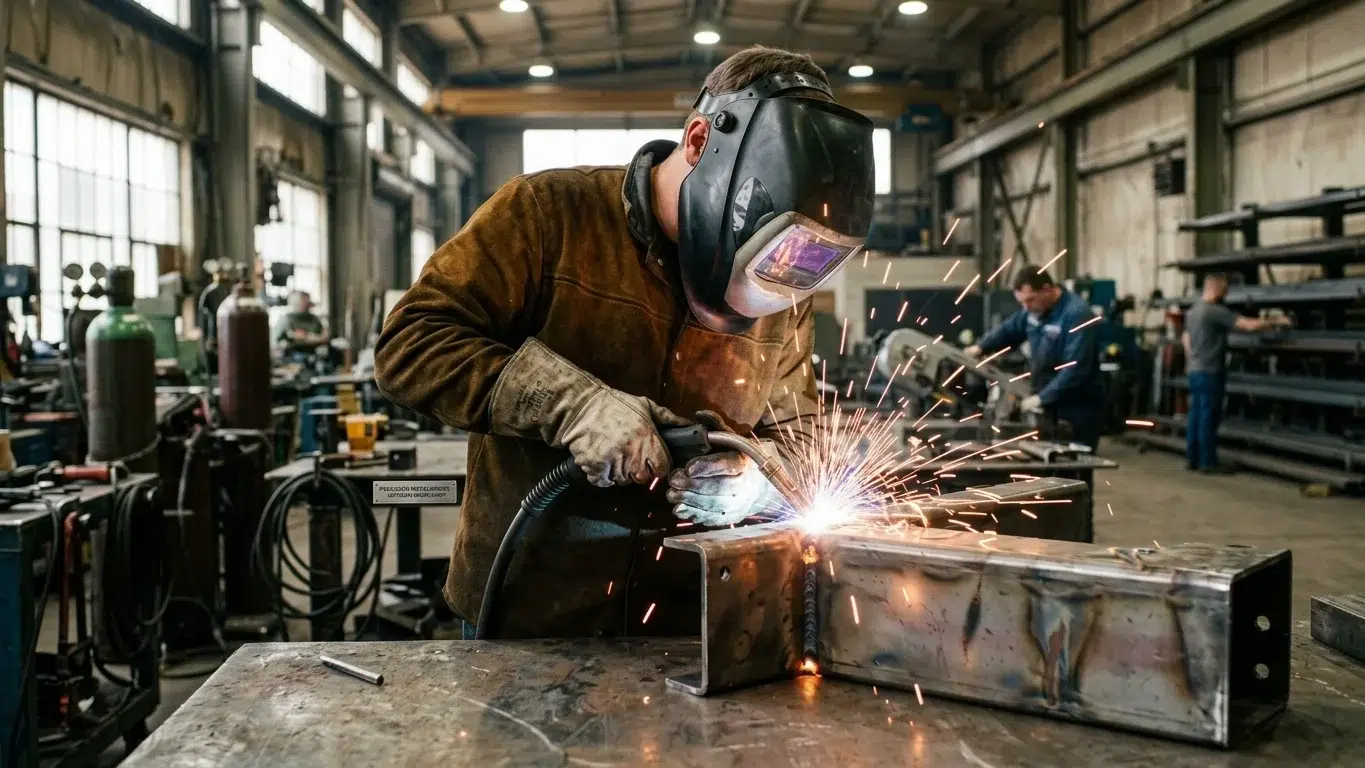
TIG welding offers cleaner and more precise welds for thin metals, while arc welding provides strong and durable welds for thick steel and demanding conditions. This guide explains their key differences, pros, costs and applications to help you choose the right process for your work.
Most welding problems start before the arc is ever struck. Someone picks a process that does not suit the metal, the site or the finish they need, and the job turns into grinding, rework and wasted rod. TIG welding and arc welding both make sound joints, but they behave very differently once you start working with them.
This guide on TIG vs arc welding covers the differences, pros and applications of each process, along with what they cost to run. By the end you should know which one fits your material, your workspace and your budget.
What Is the Main Difference Between TIG Welding and Arc Welding?
The main difference is the electrode. TIG welding uses a tungsten electrode that does not burn away, with a separate filler rod and shielding gas. Arc welding, also called stick welding, uses a flux coated rod that melts into the joint and creates its own shielding. That one change drives cost, skill and finish.
Both are electric arc processes. Both need a power source, a ground clamp and a steady hand. What separates them is how heat and filler metal are handled.
With TIG welding, the welder controls heat and filler independently. With arc welding, the rod does both jobs at once. That is why TIG feels like fine handwork and arc welding feels like laying down a strong, steady line.
How Does TIG Welding Work and What Are Its Pros?
TIG welding creates an arc between a tungsten electrode and the workpiece while argon gas protects the molten pool. The welder feeds filler rod by hand and often adjusts amperage with a foot pedal. The result is a tight, clean bead with almost no spatter.
It rewards patience. On thin stainless or aluminium, nothing else gives you the same control over heat, which is what keeps panels from warping or burning through.
The main advantages of TIG welding are
- Clean, smooth beads with very little cleanup after welding
- Excellent control on thin and heat sensitive metals
- Works on stainless steel, aluminium, titanium and magnesium
- Minimal spatter and no slag to chip away
The tradeoff is speed and skill. A good TIG operator takes months to develop, and the process needs clean metal to perform well.
How Does Arc Welding Work and What Are Its Pros?
Arc welding strikes an arc between a flux coated electrode and the metal. The rod melts into the joint while the flux burns off as gas and slag, protecting the weld from air. No gas bottle is needed, which keeps the setup simple and portable.
This is the process you see on construction sites, pipelines and repair jobs. It forgives rust, paint and wind in a way TIG welding never will.
The main advantages of arc welding are
- Deep penetration and strong joints on thick steel
- Works outdoors and on dirty or rusty surfaces
- Low equipment cost and easy to carry between sites
- Shorter learning curve for basic work
The tradeoff is appearance. Arc welds are rougher, throw spatter and need slag removal. If the weld will be visible, expect to grind it.
TIG vs Arc Welding Side by Side
The table below shows how the two processes compare on the points buyers ask about most.
| Feature | TIG Welding | Arc Welding |
| Weld appearance | Clean and smooth | Rougher, needs cleanup |
| Best thickness | Thin to medium | Medium to thick |
| Speed | Slower | Faster |
| Skill needed | High | Low to moderate |
| Shielding gas | Required, usually argon | Not required |
| Portability | Limited | High |
| Running cost | Higher | Lower |
Where Are TIG Welding and Arc Welding Used?
TIG welding is used where precision and appearance matter, such as food grade tanks, aerospace parts and exhaust systems. Arc welding is used where strength and toughness matter, such as structural steel, pipelines and heavy equipment repair. Matching the application to the process saves time and money.
TIG welding is common in these jobs
- Stainless steel and aluminium fabrication
- Medical and food grade equipment
- Automotive and motorsport exhausts
- Thin sheet and tube work
Arc welding is common in these jobs
- Construction and structural steel
- Pipeline installation and repair
- Heavy machinery maintenance
- Outdoor and emergency repairs
In practice, the job site often decides TIG vs arc welding before anything else. In a clean indoor workshop, TIG welding is a realistic choice. Outdoors, with rust and wind in play, arc welding is the safer pick.
Which Process Costs More to Run?
TIG welding costs more to run. The machine is pricier, and you also pay for argon gas, tungsten electrodes and a skilled operator. Arc welding needs only a power source and rods, so both the upfront and ongoing cost are lower.
Cheaper is not always better though. If an arc weld needs an hour of grinding to look acceptable, the saving disappears. When you weigh TIG vs arc welding on cost, count labour, not just consumables.
How Do You Choose Between TIG Welding and Arc Welding?
Choose TIG welding when the metal is thin, the weld will be seen and the surface is clean. Choose arc welding when the steel is thick, the location is rough and strength matters more than looks. Three quick questions about material, environment and finish will settle most cases.
- Material. Thin stainless or aluminium points to TIG welding. Thick mild steel points to arc welding.
- Environment. Wind, rust and no gas supply point to arc welding. A controlled workshop suits TIG welding.
- Finish. Visible or food grade welds point to TIG welding. Hidden structural joints suit arc welding.
If your answers split between the two, many shops run both. A dual capability machine can cover the gap without doubling your equipment, and it is worth asking about before you buy. Anyone weighing TIG vs arc welding for a new workshop will usually land on one of these three answers.
Final Thoughts
There is no winner here, only the right tool for the work. TIG vs arc welding comes down to precision against toughness, and once you answer that, the rest follows.
If you are still unsure which process or machine suits your work, NGEN Global can help you match the equipment to your material, thickness and working conditions.
Tell us about your material, project requirements and working conditions. Our team can help you find the right welding equipment for your application and provide practical guidance before you buy.
FAQs
Which is easier to learn, TIG welding or arc welding?
Arc welding is easier to learn for most beginners. It uses simpler hand movements and one tool in one hand. TIG welding needs coordination of torch angle, filler rod and heat, often with a foot pedal, so it takes much longer to get consistent.
What is a disadvantage of TIG welding?
The main disadvantage is speed and skill. TIG welding is slow, needs very clean metal and takes real practice. It also costs more to run because of shielding gas, tungsten and higher machine prices.
What metal is TIG welding best for?
TIG welding is best for thin metals and non-ferrous materials, especially aluminium and stainless steel. It is also used on titanium, magnesium and chromoly, where clean welds and tight heat control matter.
Is arc welding stronger than TIG welding?
Not necessarily. Arc welding gives deep penetration that suits thick steel, while TIG welding produces very sound welds on thin material. Strength depends on the joint design, the settings and the welder, not only the process.
Don’t Miss to Read More Welding Machine Blogs
- What Is ARC/MMA Welding? Process, Uses & Advantages Learn the basics and applications of ARC/MMA welding.
- I Tried ARC/MMA Welding for Heavy Steel Real test results from heavy steel welding work.
- Types of Welding Machines Choose the Right One A quick breakdown to help you pick the right machine for the job.
- Top 10 Industrial Applications of Arc Welding See where arc welding machines get used across major industries.
- Best Welding Equipment Suppliers Across the UAE A roundup of trusted suppliers for sourcing welding equipment.
